
Reviewed · LONDON WALKING TOURS
City of London Historical Walking Tour
The City of London has its own story, older and more politically independent than the London most visitors picture. This walk follows that story from Celtic and Roman roots to a square mile that challenged royal power, helped shape English law, and endured plague, fire, and revolution. Guide Arjun connects the history to less obvious corners of the modern City.
I like two things in particular: the focus on small, easily missed places rather than a parade of famous sights, and the small group size, which makes it easier to ask questions and talk as you walk. The dragon emblem gives the tour a memorable thread, too, linking the City’s identity to its fight to preserve its rights.
The main consideration is that this is a history walk, not a food tour or a greatest-hits tour of London. No food is included, and if you want a quick tour of the capital’s best-known landmarks, this route takes a different path.
- Start at Barbie Green, opposite the ruins, and look for the guide’s longish hair, beard, and felt green dragon on his backpack.
- Follow the City’s long timeline, from Celtic and Roman roots through Saxon, Viking, and Norman rule.
- Explore political independence, including the City’s relationship with the monarchy and its place in England’s legal history.
- Visit named City landmarks, including Salters’ Hall, Guildhall, the Royal Exchange, Mansion House, and the Bank of England.
- Keep the group small: no more than eight participants, with a post-tour PDF to revisit the places and themes.
A different kind of London history walk
The City of London is not simply central London under another name. It is a distinct, ancient square mile with its own civic identity, and this tour sets out to explain how that identity took shape. Rather than treating the City as a backdrop for famous buildings, Arjun uses its past to show why it mattered: who held power, how the City dealt with kings, and how its institutions grew in influence.
The route covers a long span of history without trying to make every period feel like a separate lecture. You move from the Celts and Romans to Saxons, Vikings, and Normans, then into the City’s struggle to maintain its rights and its role in the foundations of English democracy and law. The story reaches the turbulent late 17th century, when plague, the Great Fire, and revolution tested the City.
That historical arc is the tour’s real value. A square mile can look compact on a map, but its meaning takes time to read. Arjun’s job is to connect the less showy locations to the larger story, so a place that might seem ordinary at first can become a clue to how London grew.
Meeting at Barbie Green and finding the dragon
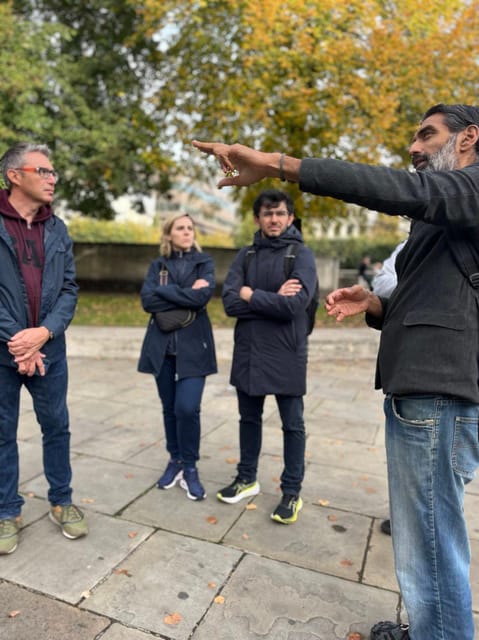
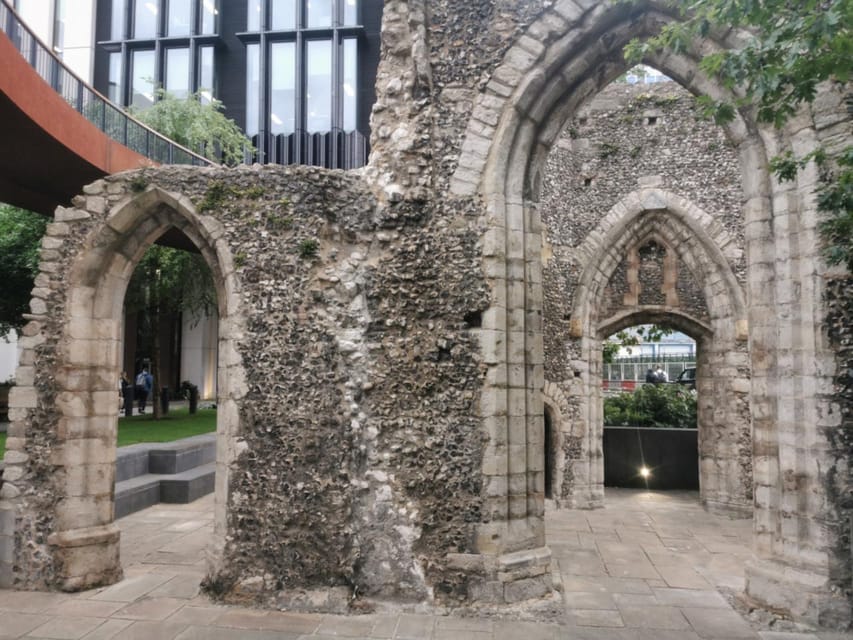
The meeting point is Barbie Green restaurant, opposite the ruins. The guide is identified by longish hair, a beard, and a felt image of a green dragon on his backpack. That detail is easy to spot and neatly previews one of the tour’s central themes: the dragon as an emblem of the City’s identity.
The group is limited to eight people. That matters on a walking tour built around conversation and explanation. You are not trying to hear a long monologue from the back of a crowd, and there is more room to ask questions as the route unfolds. People who have taken the tour describe it as friendly and engaging, with Arjun bringing both historical and contemporary City settings into the discussion.
The tour lasts 2.5 hours. Some of the timed stops are short, while others allow longer stretches of explanation, so expect a steady sequence of walking and listening rather than one long stop. Wear comfortable shoes and be ready to spend the full session outdoors. The tour has been enjoyed in grey, drizzly weather, but that is a useful reminder to bring a rain layer if the forecast calls for it.
More walking tours in London:
- Magical London: Harry Potter Guided Walking Tour
★ 4.7 · 22,044 reviews - London: The Original Jack the Ripper Walking Tour
★ 4.7 · 7,833 reviews - Tour for Muggles The Ultimate Harry Potter Walking Tour in London
★ 5.0 · 4,684 reviews
From early settlement to Roman, Saxon, Viking, and Norman London
The first part of the walk traces the City’s origins and its changing peoples. The tour begins with Celtic roots, then moves through Roman, Saxon, Viking, and Norman periods. That broad sweep helps you understand the City as a place shaped by successive cultures, not as a medieval invention or a modern business district.
The supplied route gives several guided stops before Salters’ Hall, but does not name each one. That is worth knowing if you are expecting a fixed list of famous monuments. The experience is designed around the historical interpretation of the area, and the exact value of an unnamed stop comes from what Arjun explains there, rather than from a dramatic building entrance or a major photo opportunity.
For visitors who already know London’s standard sights, this focus can be a welcome change. One person who had lived in London and returned often still found previously unknown parts of the City. Another noted that the tour made the square mile feel much larger. That is a good description of the experience: the map may look manageable, but the layers of history make each stretch feel distinct.
Salters’ Hall and the City’s civic character
Salters’ Hall is one of the named stops, with about ten minutes set aside for the guided visit. The tour places it within a wider story of the City’s institutions and identity. You are not only learning dates and names; you are considering how an organized corporation could hold rights and influence in a country ruled by a monarch.
The distinction between the City and Westminster is a key theme. The tour explains why the City developed its own character and why its independence could make it the envy of kings. This framing is especially useful if you have wondered why the City of London is treated as a separate entity within the larger capital.
The stop is also a reminder that City history is not always written in grand façades. Some locations may seem modest or easy to pass by without context. Arjun’s explanations help bring out why they matter, which is one reason the route appeals to people who want more than a checklist of landmarks.
Guildhall, democracy, and Magna Carta
Guildhall receives a longer stop, about fifteen minutes. It anchors the tour’s account of the City’s civic life and its resistance to royal authority. The core question is how a corporation could defend its privileges and become a force in the development of England’s democratic and legal foundations.
Magna Carta is part of that discussion. The tour presents the City as a birthplace of the charter and explores its significance in the wider story of law and power. This is a more useful way to approach the subject than simply memorizing a date: you see how civic rights, royal authority, and legal limits connect.
The details are delivered as a walking narrative, not as a formal classroom session. If you like history best when it is tied to places and political choices, this section should hold your attention. If your preference is for interiors, displays, or a long visit inside a single landmark, keep in mind that this is a walking tour with timed stops, not a museum visit.
More history tours in London:
- London Small Group Tour of Historical Pubs
★ 5.0 · 10,422 reviews - Soho Music & Historic Pubs Tour
★ 5.0 · 1,993 reviews - London: Historic Pubs of Central London Walking Tour
★ 4.9 · 1,065 reviews - London: Soho Music and Historic Pubs Walking Tour
★ 4.9 · 836 reviews
The corporation, the Royal Exchange, and Mansion House
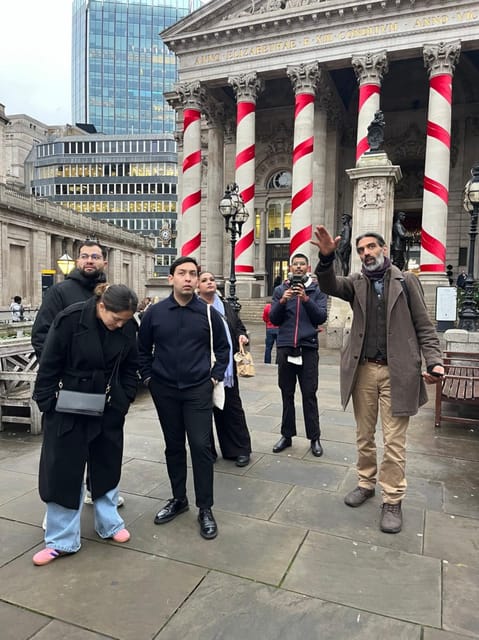
The tour then follows the City’s rise as an economic and institutional power. One of its themes is how a corporation born in the City helped drive the growth of a global empire. The wording points to a broad historical story, rather than a promise to visit a particular corporate interior, so expect explanation of the City’s influence as you move through its streets and civic sites.
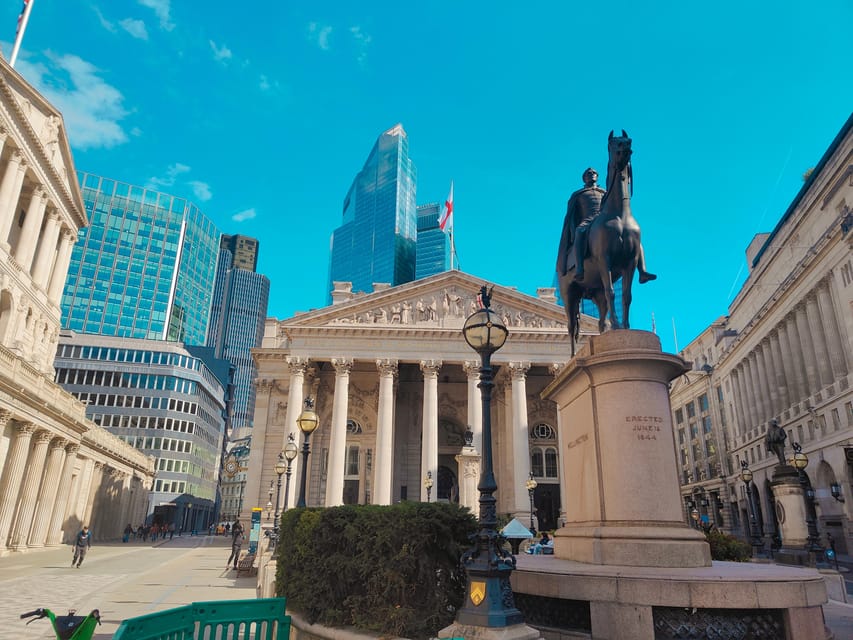
The Royal Exchange is a named stop, with about five minutes for a guided explanation. Mansion House follows, also for about five minutes. These are brief pauses, not extended visits. Their value lies in seeing them as part of the City’s public and commercial identity, then hearing how that identity fits into the larger account of power and privilege.
The itinerary also includes several other short guided stops before the Royal Exchange. Since they are not individually named, you should not book expecting a detailed building-by-building list in advance. Instead, think of the route as a sequence of historical viewpoints, some prominent and some less obvious, linked by Arjun’s account.
Plague, fire, revolution, and the dragon
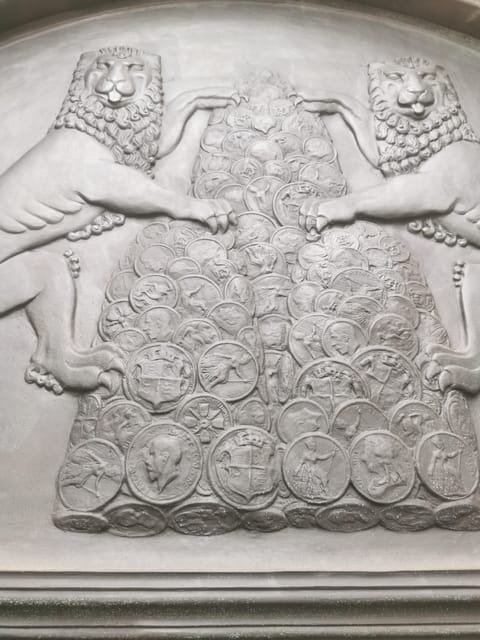
The final stretch brings the story to the close of the 17th century, when the City faced plague, the Great Fire, and revolution. These events make for a dramatic ending, but the tour’s focus is not hardship alone. It also looks at how the City recovered, protected its rights, and carried its civic identity forward.
The dragon becomes the emblem that ties the experience together. Its significance is not just decorative: it represents the City’s distinctive character and its long effort to preserve its privileges. The tour uses that symbol to connect the early history to the City that emerged from crisis.
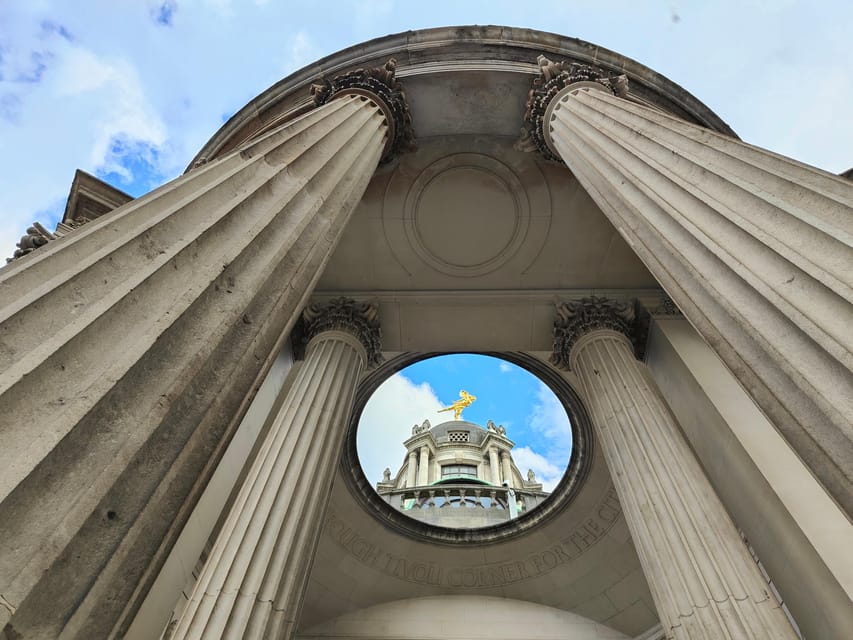
The walk ends at the Bank of England. This is a fitting endpoint for a tour that has traced the growth of civic and financial influence, though the available details describe a finish at the Bank rather than an interior visit. If you are hoping to go inside a landmark, check separately; the experience described here is a guided walking tour.
What the pace and group size mean for you
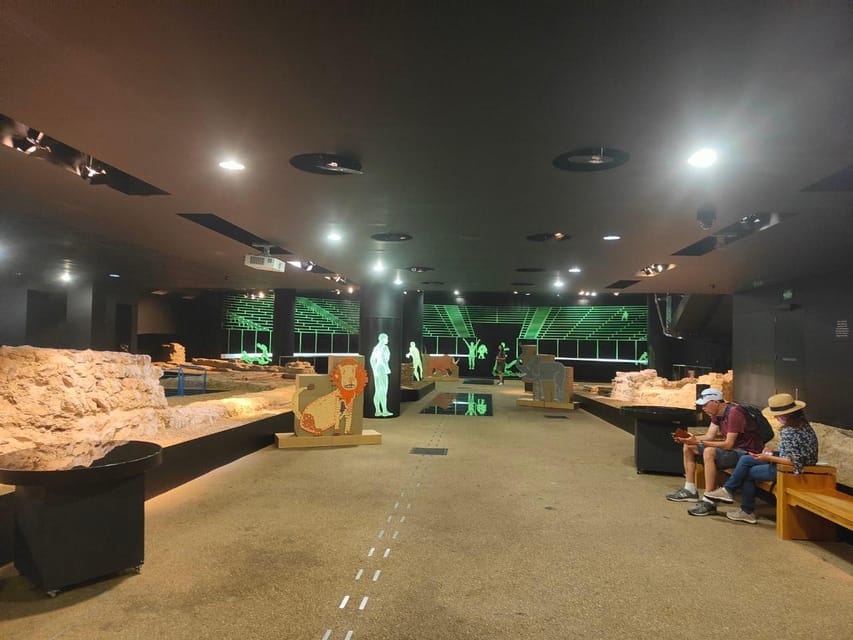
At 2.5 hours, this is a substantial walk but still manageable as a half-day activity. The timed segments add up to nearly the full session, with the rest of the time naturally taken by moving between stops. The group cap of eight should make it easier to stay connected to the guide and follow the story, especially at shorter stops.
The subject matter is dense, but the route is not presented as a nonstop list of facts. Arjun is described as a natural storyteller, and the strongest praise focuses on his ability to make obscure places interesting and link historical and contemporary City life. If you enjoy asking questions or talking through what you have just heard, the small group is a real advantage.
The tour is listed as wheelchair accessible. It is conducted in English, and the activity information says to ask in advance about another language. A post-tour PDF covering locations and themes is included, which is useful if you want to remember the route or continue reading after the walk.
Is $30 a fair price?
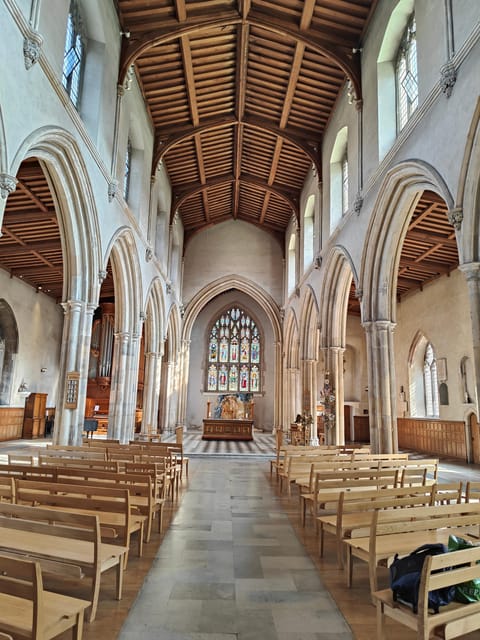
At $30 per person, the price is reasonable for a 2.5-hour guided walk with a maximum of eight participants and a follow-up PDF. You are paying for interpretation and access to a carefully connected story, not for food, transport, or entry to attractions. That distinction helps set expectations: the tour’s value depends on your interest in the City’s history and on having a guide who can make its less obvious details meaningful.
I would consider it particularly good value if you have already seen the usual London sights, or if you want to understand why the City is more than a cluster of financial buildings. First-time visitors can also benefit, especially if they want a historical framework before exploring on their own. But if you want a fast overview of major London landmarks, there are better-matched options.
The tour offers free cancellation up to 24 hours before the start, and you can reserve now and pay later. Starting times vary, so check availability when choosing a date. No food is served, so plan a meal or snack before or after the walk.
Who should book the City of London Historical Walking Tour?
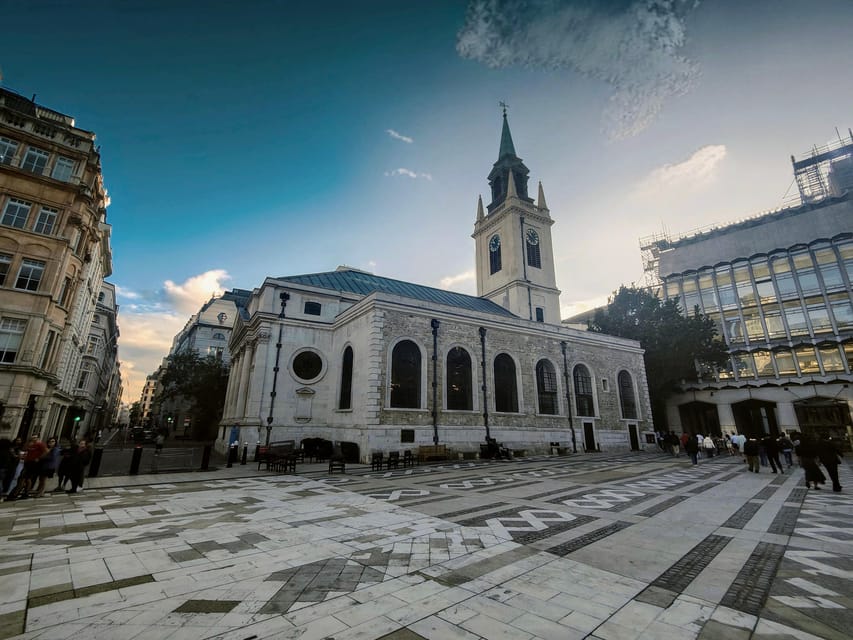
Book this tour if you enjoy political history, civic identity, and stories that give overlooked places a reason to matter. It is particularly well suited to repeat visitors and anyone curious about the difference between the City and Westminster. The small group and Arjun’s conversational style also suit people who prefer a discussion to a large, scripted tour.
Think twice if you mainly want iconic photo stops, indoor attractions, or a food-focused outing. This is a history-first walk, and some of its stops are short or visually modest. But if you are willing to listen closely, the City’s quieter corners can offer a more revealing view of London than another pass by the best-known sights.
FAQ
How long is the City of London Historical Walking Tour?
The tour lasts 2.5 hours.
Where does the tour start and finish?
It starts at Barbie Green restaurant, opposite the ruins, and finishes at the Bank of England.
How do I recognize the guide?
Look for a guide with longish hair and a beard, carrying a backpack with a felt green dragon image.
What is the maximum group size?
The tour is limited to eight participants.
What language is the tour conducted in?
English is listed as the tour language. The activity information says to ask in advance if you need another language.
Is food included?
No. Food is not served on this tour.
Just reviewed in London
- Doctor Who London Walking Tour★ 4.9 · 137 reviews
- From London: Windsor, Stonehenge, & Salisbury Cathedral Trip★ 3.8 · 46 reviews
- Destination London: E-Bike Tour★ 5.0 · 3 reviews
- Cardiff Day Tour from London with Local Guide (Visit Wales)★ 4.0 · 20 reviews
- Devon and Cornwall: 5-Day Tour from London★ 4.7 · 115 reviews
- Camden: Explore London’s Creative Side with a Local Host★ 4.9 · 10 reviews
- From London: Oxford, Stratford, Cotswolds & Warwick Castle★ 4.3 · 110 reviews
- London: Guided E-bike Tour★ 4.6 · 63 reviews
London Walking Tours, compared.

Magical London: Harry Potter Guided Walking Tour
Read our review →

Tour for Muggles The Ultimate Harry Potter Walking Tour in London
Read our review →
Harry Potter Movies Walking Tour (Kids Go Free)
Read our review →
Changing of the Guard Guided Walking Tour in London
Read our review →
The Great British Rock and Roll Music Walking Tour
Read our review →
Jack the Ripper Walking Tour – Ripper Vision Tours
Read our review →Browse the lists this tour appears in